Thermostat Repair in Dubai: Why Your AC Won't Respond to Temperature Settings
SAAD MAAZ HVAC Engineering Team
Written by Saad Maaz (Lead HVAC Specialist) • Updated May 26, 2026 • 11 Min Read
Quick Summary
The thermostat is the "command centre" of your AC. A blank screen usually means a blown 24V transformer or fuse inside the indoor unit - not a dead thermostat. Before replacing the whole thermostat, always check the 24V AC supply from the indoor unit's control board first. Our engineers carry multimeters and spare transformers for on-the-spot diagnosis and repair.
Guide Directory
You press the power button on your thermostat. Nothing happens. Or worse, the display is on, the temperature is set to 22°C, yet the room feels like 32°C because the compressor never kicks in. The thermostat is the communication bridge between you and the air conditioner's brain - when it breaks, the entire system goes silent.
At SAAD MAAZ Technical Services LLC, thermostat-related complaints are among our top five service calls in Dubai. The good news is that most thermostat problems are not caused by the thermostat itself. They are caused by upstream electrical faults in the indoor unit's control board. This guide breaks down the true causes and the professional repair procedures we follow.
Thermostat Completely Dead?
Don't replace it blindly. The problem is likely a blown fuse or transformer inside your AC. Let us check first.
1. How an AC Thermostat Actually Works
Unlike your home's light switch, which uses 220V mains electricity, most AC thermostats operate on a safe 24V AC low-voltage circuit. Inside your indoor unit (or ducted handler), a small step-down transformer converts 220V to 24V. This 24V power travels through thin thermostat wires to the wall-mounted thermostat. When you set the thermostat to "Cool" at 22°C, it closes an internal relay on the "Y" (Yellow/Cooling) wire, sending 24V back to the outdoor unit's contactor coil, which energizes and starts the compressor.
Understanding this circuit is critical because it means a "dead thermostat" could actually be a dead transformer, a blown fuse on the PCB, or a broken wire anywhere in this chain.
2. Blank Screen: The Transformer & Fuse Check
Our diagnostic protocol for a blank thermostat screen starts at the indoor unit, not at the thermostat. We open the indoor unit's electrical panel and test the output of the 24V step-down transformer using a multimeter. If we get 0V, the transformer is dead and needs replacement (a common AED 200-300 part).
If the transformer outputs 24V correctly, we check the 3-amp or 5-amp glass blade fuse on the PCB board. These fuses blow frequently during voltage spikes (common during Dubai thunderstorms or DEWA grid switching). A blown fuse costs less than AED 10 to replace but can render the entire AC inoperable.
AC Stops After a Power Cut?
Voltage surges during power restoration commonly blow the control fuse. A 5-minute fix by our technician.
3. Display On But Won't Trigger Cooling
If the thermostat display is powered and showing the temperature, but setting it to "Cool" doesn't start the outdoor unit, the fault lies in the control signal path. We test with a multimeter at the thermostat's "Y" terminal. If 24V appears there when calling for cooling, the thermostat is fine - the problem is downstream (broken wire to outdoor unit or a burnt contactor coil).
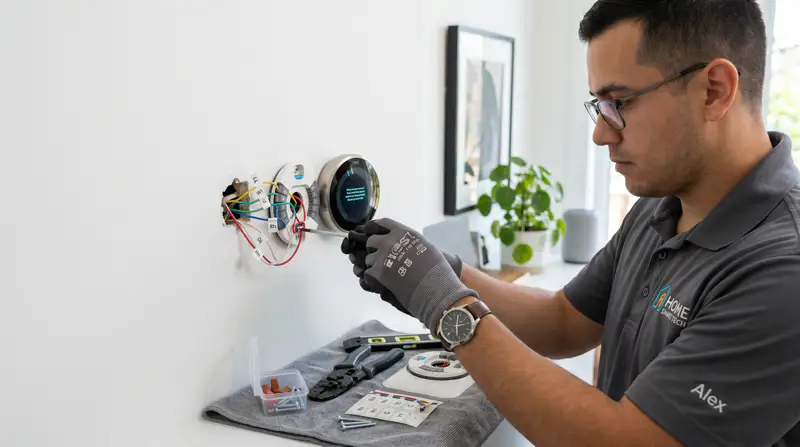
If no voltage appears on the "Y" terminal, the thermostat's internal relay has failed and the thermostat needs replacement. We also check the "C" (Common) wire, which is essential for powering modern digital and Wi-Fi thermostats. Many older Dubai installations lack a "C" wire, causing intermittent power issues with smart thermostats.
4. Temperature Calibration & Sensor Drift
Some thermostats develop calibration drift over the years. The display might show 24°C, but the actual room temperature measured by an independent thermometer is 27°C. This means the thermostat "thinks" the room is cool enough and never calls for additional cooling.
Most digital thermostats have a calibration offset setting (typically ±3°C) in their advanced menu. We adjust this to match the real room temperature. If the internal NTC thermistor sensor has physically degraded, we replace the thermostat entirely.
5. Upgrading to Smart Wi-Fi Thermostats
Many Dubai homeowners are upgrading from basic on/off thermostats to programmable or Wi-Fi smart thermostats. These allow you to control your AC remotely via smartphone, set weekly schedules, and even integrate with Google Home or Alexa.
The critical requirement for a smart thermostat is a "C" (Common) wire providing continuous 24V power. Without it, the thermostat will intermittently lose power and disconnect from Wi-Fi. In older installations that only have 2 wires (R and Y), we can run a new "C" wire from the indoor unit or install a "C-wire adapter" module inside the indoor unit to provide the missing power.
Thermostat Repair & Replacement Cost Table
| Service | Price Range | Includes |
|---|---|---|
| Diagnostic + Fuse / Wiring Fix | AED 150 - AED 250 | Multimeter tracing, fuse or wire repair |
| 24V Transformer Replacement | AED 200 - AED 350 | OEM or universal transformer + labor |
| Digital Thermostat Replacement | AED 250 - AED 450 | New thermostat unit + wiring + calibration |
| Smart Wi-Fi Thermostat Upgrade | AED 400 - AED 700 | Smart thermostat + C-wire adapter + setup |
Frequently Asked Questions
Why is my AC thermostat screen blank?
Why does the thermostat show the correct temperature but AC won't turn on?
Can you upgrade my old dial thermostat to a digital one?
How much does thermostat repair cost in Dubai?
About The Author: Saad Maaz
Lead HVAC Controls & Automation Specialist
Saad Maaz is the Lead Technical Consultant at SAAD MAAZ Technical Services LLC. Specializing in HVAC control circuitry, low-voltage wiring, and smart thermostat integration, he has resolved thousands of thermostat and PCB-related faults across Dubai's residential and commercial properties.