AC Diagnostics in Dubai: How We Pinpoint the Exact Fault
SAAD MAAZ HVAC Engineering Team
Written by Saad Maaz (Lead HVAC Specialist) • Updated May 26, 2026 • 13 Min Read
Quick Summary: The Diagnostic Process
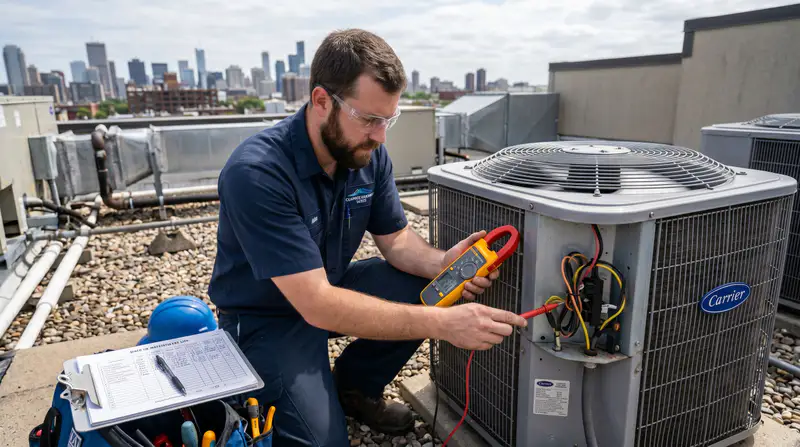
A professional AC diagnostic eliminates guesswork. By utilizing digital manifold gauges to check refrigerant subcooling and superheat, alongside RMS multimeters to test capacitors (microfarads) and compressor amperage, technicians can determine exactly why your AC isn't cooling. Avoid contractors who blindly top up gas without pressure-testing the system first.
Guide Directory (Jump to Section)
- 1. Why Guesswork Costs You Money
- 2. Electrical Testing: Capacitors & Contactors
- 3. Refrigerant Pressure & Leak Detection
- 4. Airflow Analysis: Coils and Motors
- 5. Thermostat & PCB Low-Voltage Checks
- Dubai Diagnostic Callout Cost Table
- Hyperlocal Focus: Deira & Naif Old Wiring Issues
- Frequently Answered Diagnostic Questions
When your air conditioner breaks down in the middle of a Dubai summer, panic often leads to hasty decisions. Many homeowners fall victim to uncertified technicians who briefly look at the machine, declare that it "needs gas," charge AED 300, and leave - only for the AC to break down again a week later.
At SAAD MAAZ Technical Services LLC, we believe that an accurate repair begins with an accurate diagnosis. Modern air conditioners are complex thermodynamic and electrical systems. You cannot fix them simply by looking at them; you must test them. This guide explains the rigorous step-by-step diagnostic protocol our engineers follow to pinpoint the root cause of your AC failure, ensuring we fix it right the first time.
AC Not Cooling? Stop Guessing.
Book a professional diagnostic check. We waive the inspection fee if you proceed with our repair.
1. Why Guesswork Costs You Money
Consider a common symptom: The indoor unit is blowing warm air. A novice might assume the unit is out of gas. However, warm air can be caused by a burnt start capacitor, a pitted magnetic contactor, a seized outdoor fan motor, a faulty thermistor, or a tripped high-pressure switch.
If a technician "tops up the gas" when the real issue is a failing fan motor, the compressor will overheat due to extreme head pressure and eventually burn out its internal windings. A simple AED 250 repair turns into an AED 1,500 compressor replacement. Thorough diagnostics prevent this cascading failure.
2. Electrical Testing: Capacitors & Contactors
More than 60% of all AC breakdowns in Dubai are electrical, not mechanical. The severe desert heat degrades electrical components rapidly.
Our first diagnostic step at the outdoor condensing unit involves isolating the power and testing the dual-run capacitor. Using a multimeter set to capacitance mode, we check the microfarad (µF) reading. If a capacitor rated for 45 µF reads 30 µF, it is failing and will struggle to start the heavy compressor, leading to "Locked Rotor Amps" (LRA) which trips your main breaker. We also inspect the magnetic contactor for carbon pitting - burnt contacts create resistance, causing voltage drops and extreme heat.
Is Your AC Tripping the Breaker?
This indicates a dangerous electrical short. Do not keep resetting it. Let our experts test the circuit.
3. Refrigerant Pressure & Leak Detection
An air conditioner is a sealed hermetic system. It does not "consume" gas like a car consumes petrol. If the refrigerant is low, there is a physical leak in the copper piping or coils.
We attach manifold gauges to the service valves. For an R410a system, the suction (low) pressure should typically read between 115 to 130 PSI, depending on ambient temperature. We don't just look at pressure; we calculate Superheat (suction line temperature minus saturation temperature) and Subcooling to determine exactly how much liquid vs. vapor is in the system. If the system is low, we use electronic halogen leak detectors or UV dye to find the micro-leak before proposing a recharge.
4. Airflow Analysis: Coils and Motors
Refrigeration requires airflow to work. If the indoor evaporator coil is blocked by a thick mat of dust, or the indoor blower motor is rotating slowly due to failing bearings, the refrigerant inside the coil cannot absorb heat from the room.
This causes the coil temperature to drop below 0°C, and the condensation freezes into a solid block of ice. We diagnose airflow by checking the temperature drop (Delta T) across the supply and return vents. A healthy AC should have a Delta T of about 15°F to 20°F. If the Delta T is extreme, we know there is an airflow restriction requiring a deep chemical wash.
5. Thermostat & PCB Low-Voltage Checks
Sometimes the mechanical components are perfectly fine, but the brain of the AC - the thermostat or Printed Circuit Board (PCB) - is failing to send the "cool" signal.
We test the 24V AC low-voltage control wires using a multimeter. We verify that 24 volts are leaving the thermostat's 'Y' (Cooling) terminal and reaching the outdoor contactor coil. We also check the continuity of temperature thermistors (sensors) that tell the PCB when the room has reached the desired temperature.
Dubai Diagnostic & Callout Cost Table
We believe in complete transparency. Our diagnostic fee covers the technician's travel, fuel, and the 30-45 minutes of rigorous testing required to find the fault.
| Service Type | Standard Rate | Policy Note |
|---|---|---|
| Standard Diagnostic / Callout Fee | AED 100 - AED 150 | Waived if you proceed with the repair. |
| Minor Fix (e.g. Capacitor, Contactor) | AED 200 - AED 350 | Includes the part, labor, and diagnostic waiver. |
| Major Fix (e.g. Gas Leak Repair) | AED 400 - AED 800+ | Requires nitrogen pressure test and brazing. |
Hyperlocal Focus: Older Wiring in Deira & Naif
When diagnosing AC units in older, historic districts of Dubai such as Deira and Naif, our technicians frequently encounter legacy electrical infrastructure.
Older apartment blocks may suffer from voltage drops during peak summer hours when thousands of window units and splits turn on simultaneously. A voltage drop below 200V can prevent a compressor from starting. In these areas, our diagnostics heavily focus on installing Hard Start Kits (Boosters) to assist older compressors in overcoming low voltage supply, saving the residents from needing entirely new units.
Frequently Asked Questions (FAQ)
What is included in a professional AC diagnostic?
Why is my AC running but not cooling the room?
How much does an AC diagnostic inspection cost in Dubai?
Why does the AC trip the main circuit breaker?
About The Author: Saad Maaz
Lead HVAC Diagnostics Specialist
Saad Maaz is the Chief Technical Diagnostics Engineer at SAAD MAAZ Technical Services LLC. With over 12 years of specialized experience troubleshooting advanced Inverter PCBs, VRF systems, and commercial refrigeration circuits across the UAE, he ensures that every repair is based on precise electrical and thermodynamic data, rather than guesswork.