Comprehensive HVAC Repair in Dubai: Master Level System Diagnostics
SAAD MAAZ HVAC Engineering Team
Written by Saad Maaz (Lead HVAC Specialist) • Updated May 26, 2026 • 15 Min Read
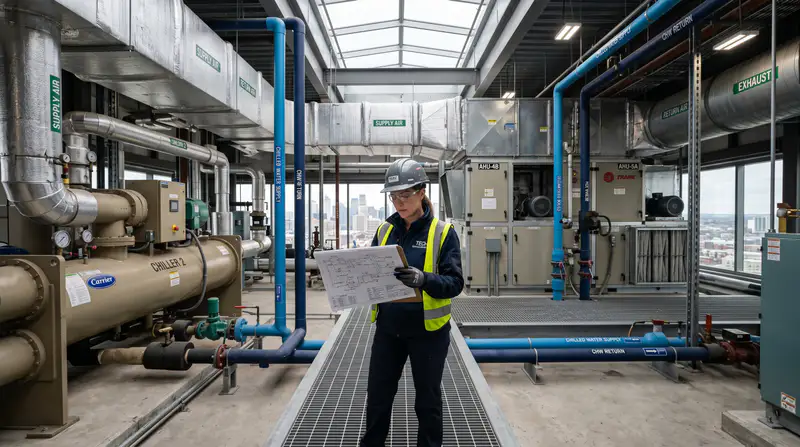
Quick Summary: Complex HVAC Failures
HVAC systems in Dubai face extreme operational stress due to 50°C summer peaks and high humidity. The most critical HVAC repairs involve replacing burnt compressor dual-run capacitors, fixing catastrophic refrigerant leaks in high-pressure copper lines, clearing heavily blocked biological drain pans to prevent ceiling water leaks, and diagnosing complex inverter PCB (Printed Circuit Board) communication errors.
Guide Directory (Jump to Section)
- 1. Core HVAC Components in the UAE Climate
- 2. Inverter vs. Non-Inverter Compressor Failures
- 3. The Importance of Airflow: Coils and Filtration
- 4. Electronic Control Board (PCB) and Thermostat Faults
- 5. Commercial vs. Residential HVAC Repair Challenges
- Dubai HVAC Repair Cost Table (2026 Slabs)
- Preventative Maintenance vs. Reactive Repair
- Hyperlocal Factors: Rooftop Units in Jumeirah vs. VRF
- Frequently Answered HVAC Questions
Heating, Ventilation, and Air Conditioning (HVAC) systems are marvels of modern thermodynamic engineering. In Dubai, the "Heating" aspect is rarely utilized, but the Ventilation and Air Conditioning demands are among the highest in the world. From massive VRF (Variable Refrigerant Flow) networks in Downtown high-rises to concealed ducted split systems in suburban villas, an HVAC breakdown is a complex mechanical failure requiring deep technical expertise to resolve.
At SAAD MAAZ Technical Services LLC, we move beyond basic "gas top-ups." We perform comprehensive subcooling and superheat calculations, psychrometric airflow analysis, and component-level PCB diagnostics. This guide breaks down the true engineering behind HVAC failures and how our licensed professionals repair them.
Require Professional HVAC Diagnostics?
Stop guessing. Let our certified engineers perform a complete thermal and electrical audit of your system.
1. Core HVAC Components in the UAE Climate
An HVAC system is not a single appliance; it is a synchronized network of specialized mechanical devices. The primary loop consists of the compressor (the heart), the condenser coil (the heat rejector), the metering device (electronic expansion valve or capillary tube), and the evaporator coil (the heat absorber).
In Dubai, the condenser coil operates in hostile territory. Placed on scorching rooftops or sandy balconies, it must reject heat into ambient air that is already 45°C. This forces the compressor to work at much higher discharge pressures (head pressure) than systems in cooler climates. Consequently, the oil inside the compressor degrades faster, and the fan motors endure immense thermal wear. Understanding this high-stress environment is key to accurate HVAC diagnostics.
2. Inverter vs. Non-Inverter Compressor Failures
The HVAC industry in the UAE has largely transitioned to Inverter Technology (DC variable-speed compressors). Older non-inverter systems use AC induction motors that turn on at 100% capacity and shut off when the target temperature is reached. When these fail, the diagnosis is usually straightforward: a blown run capacitor, a welded contactor, or a seized mechanical piston.
Inverter compressors, however, operate on Direct Current (DC). They ramp up and down smoothly based on thermal load. They do not use standard capacitors. Instead, an Intelligent Power Module (IPM) on the outdoor PCB rectifies AC power to DC, then pulses it to the compressor to control its speed. When an inverter HVAC unit fails, it is almost always an electronic fault. Voltage spikes from the grid can fry the IGBT (Insulated-Gate Bipolar Transistor) bridge on the board. Our technicians use specialized digital oscilloscopes and multi-meters to read the exact DC voltage drop across the IPM terminals to diagnose the failure without blindly replacing expensive parts.
Inverter AC Showing Error Codes?
Inverter technology requires advanced electronic diagnostics. We have the tools to decode and fix PCB faults.
3. The Importance of Airflow: Evaporator Coils and Filtration
Airflow is the lifeblood of an HVAC system. In ducted split systems, a massive blower motor pulls warm air from the rooms through return grilles, pushes it across the icy-cold evaporator fins, and distributes it via galvanized ductwork.
In Dubai's dusty environment, if the return air filters are bypassed, torn, or neglected, fine particulate matter coats the wet evaporator coil. This creates an insulating mud layer. The heat transfer coefficient plummets. The refrigerant inside the coil cannot absorb heat, causing its temperature to drop below 0°C. The coil turns into a block of solid ice, restricting airflow entirely. Our HVAC engineers perform heavy-duty chemical coil cleaning, utilizing alkaline-based, non-corrosive foaming agents to strip away biological and mineral buildup, restoring optimal CFM (Cubic Feet per Minute) airflow.
4. Electronic Control Board (PCB) and Thermostat Faults
Modern HVAC units are essentially computers attached to a refrigeration loop. The PCB (Printed Circuit Board) controls the entire sequence of operations: turning on the indoor fan, engaging the reversing valve, and signaling the compressor to start.
High ambient temperatures and high humidity in mechanical rooms can cause microscopic corrosion on the PCB solder joints. Furthermore, pests (like geckos or ants) frequently crawl onto the warm boards, bridging high-voltage traces and causing explosive short circuits. A faulty thermostat might display the correct temperature but fail to send the 24V signal down the 'Y' wire to call for cooling. We meticulously test the entire low-voltage control circuit from the wall thermostat down to the outdoor unit's terminal block to isolate communication breakdowns.
Dubai HVAC Repair Cost Table (2026 Slabs)
SAAD MAAZ Technical Services LLC operates with complete transparency. Below is a structured rate card for standard and advanced HVAC repair procedures in Dubai:
| HVAC Service Type | Typical Price Range | Warranty Covered |
|---|---|---|
| HVAC Diagnostic Audit & Callout Fee | AED 100 (Waived on repair) | N/A |
| Inverter PCB Repair (Component Level) | AED 350 - AED 650 | 90 Days Board Warranty |
| Heavy Duty Chemical Coil Wash & Fin Straightening | AED 250 - AED 400 | Improved Airflow Guarantee |
| Ducted HVAC Blower Motor Replacement | AED 450 - AED 850 | 90 Days OEM Warranty |
| Thermostat Replacement (Digital/Smart) | AED 180 - AED 450 (Plus hardware cost) | 1 Year Hardware Warranty |
| Major Refrigerant Leak Repair & Vacuum Protocol | AED 550 - AED 1200 (Based on tonnage) | 180 Days Brazing Warranty |
Hyperlocal Factors: Rooftop Package Units in Jumeirah vs. VRF
HVAC systems vary drastically depending on the architectural style of the Dubai neighborhood. In sprawling villa communities like Jumeirah or Arabian Ranches, large 5-ton to 10-ton Rooftop Package Units (RTUs) are common. These massive self-contained systems sit on flat roofs, exposing them to direct UV radiation and extreme heat. The belts driving the massive blower motors dry out and snap frequently, requiring precision tensioning.
Conversely, in high-density commercial towers or luxury apartments in Downtown Dubai or Marina, VRF (Variable Refrigerant Flow) systems are the standard. These utilize a single massive outdoor unit connected to multiple indoor cassettes via a complex network of copper branch joints (Y-joints). A leak in a VRF system is a nightmare without proper diagnostics, as it can affect the entire floor. Our engineers utilize ultrasonic leak detectors and electronic sniffers tuned specifically to R410a and R32 to pinpoint micro-leaks in these massive networks without tearing down entire false ceilings.
Frequently Asked Questions (FAQ)
What is the difference between standard AC repair and HVAC repair?
Why is my inverter HVAC system giving a communication error?
How often should commercial HVAC systems be serviced in Dubai?
Does SAAD MAAZ repair ducted split HVAC systems?
About The Author: Saad Maaz
Lead HVAC Mechanical Director & Field Consultant
Saad Maaz is the Lead Technical Consultant at SAAD MAAZ Technical Services LLC. With over 12 years of hands-on experience troubleshooting, designing, and maintaining high-performance VRF, split, and commercial ducted air conditioning systems in Dubai, he provides expert HVAC diagnostic consultation to residential homeowners and corporate properties throughout the UAE.