AC Not Cooling in Dubai? Causes, Diagnostics & Fast Fixes
SAAD MAAZ HVAC Engineering Team
Written by Saad Maaz (Lead HVAC Specialist) • Updated May 26, 2026 • 10 Min Read
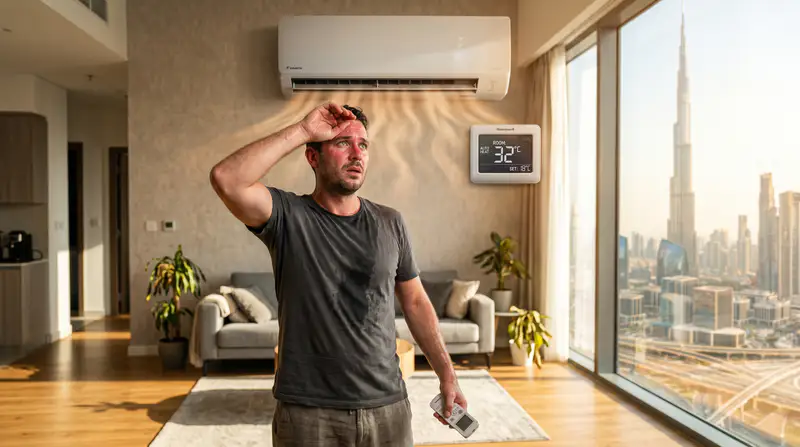
Quick Summary: What Causes AC Not Cooling?
Low refrigerant gas (R410a/R22), heavily clogged return air filters, a blown starter capacitor in the outdoor compressor, layers of desert dust coating the outdoor condenser coils, and malfunctioning digital thermostats are the most frequent reasons split and central air conditioning systems stop cooling in Dubai's extreme summer heat.
Guide Directory (Jump to Section)
- 1. Heavily Clogged Air Filters (Airflow Blocks)
- 2. Low AC Refrigerant Gas & Copper Line Leaks
- 3. Blown Outdoor Compressor Starter Capacitor
- 4. Sandy & Blocked Condenser Heat Dissipation Coils
- 5. Faulty Digital Thermostat or Control Board Relay
- Dubai AC Repair Cost Table (2026 Tariff)
- DIY Checks vs. Calling a Licensed HVAC Tech
- Hyperlocal Factors: Exhaust Stacks in Dubai Apartments
- Frequently Answered HVAC Questions
In the extreme summer climate of Dubai, where outdoor temperatures regularly exceed 45°C (113°F) and relative humidity peaks beyond 80%, a properly functioning air conditioner is not a luxury - it is an absolute safety and health requirement. When your split AC, ducted ceiling unit, or VRF cooling system starts blowing warm air instead of crisp, chilly air, comfort drops instantly.
At SAAD MAAZ Technical Services LLC, we have performed thousands of HVAC diagnostics in residential and commercial buildings across Dubai. Below is our definitive, technical diagnostic checklist detailing the causes behind cooling failures, diagnostic protocols, and precise repair steps.
AC Blowing Warm Air?
A failed starting capacitor or burnt contactor is likely preventing your outdoor unit from cooling. Let us replace it safely.
1. Heavily Clogged Return Air Filters (Airflow Blockage)
In Dubai's highly dry, dusty, and sand-swept desert environment, indoor air particles accumulate rapidly. The return air grille draws air into the AC cabinet, passing through thin plastic meshes (filters) to capture dust. Over 2 to 3 weeks of continuous summer operation, these filters capture massive coats of debris.
When air filters are completely blocked, the return volumetric airflow rate drops drastically. The cooling coil (evaporator) inside the ceiling continues to absorb refrigerant heat load but has no warm room air passing over it. This thermal drop causes the moisture on the copper fins to freeze instantly, creating thick coats of ice. The frozen ice completely blocks the air path, forcing the system to blow zero air, or a warm breeze as the air bypasses the frozen evaporator block.
Diagnostic Protocol & Repair: Turn off the AC system entirely to allow any ice accumulation on the coil to melt completely. Pull down the front cover panel of the indoor wall split or access the ceiling diffuser access panel. Slide out the return filters. Wash them under normal pressure running tap water without using harsh chemicals. Let them dry completely, then slide them back in. If filters are torn or severely warped, contact our AC Repair Dubai team to cut and fit customized replacement filters on the spot.
2. Low AC Refrigerant Gas & Copper Pipe Leaks
The chemical refrigerant (primarily R410a in modern inverter split units, and R22 in older mechanical models) serves as the medium that absorbs heat from your rooms and transports it outside. Refrigerant operates inside a hermetically sealed copper piping loop under high pressure. AC units do not consume gas; a drop in pressure indicates a physical structural leak.
Leaks commonly develop at the brazed flare brass joints connecting the indoor evaporator unit to the outdoor condenser unit, or due to micro-frictional vibration wear in the copper return bends inside the outdoor coil. When refrigerant pressure drops below standard operating slabs (e.g., below 120 PSI for R410a systems), the cooling capacity drops drastically, and the unit fails to lower the room temperature while running the compressor continuously, leading to high DEWA power bills.
Danger of Quick Recharges: Never allow an uncertified mechanic to simply top-up the gas without locating the leak. The gas will escape again in a few weeks. Our certified mechanical technicians perform a structured leak sweep: we pump dry nitrogen gas at high pressure (350-400 PSI) into the copper loop, carry out a soap bubble trace or digital halogen leak diagnostics, patch the copper lines through specialized oxygen-acetylene brazing, pull a deep vacuum down to 500 microns, and finally charge fresh gas using electronic scale weighing as per OEM plate values. Visit our dedicated AC Gas Refill Dubai service for exact booking protocols.
3. Blown Outdoor Compressor Starter Capacitor
The AC compressor and the outdoor condenser fan motor require a massive surge of electrical current to start running. This surge is supplied by the starting/running dual capacitor - a small metal cylinder located in the electrical box of the outdoor unit. In Dubai, outdoor ambient temperatures on balconies or rooftops can exceed 50°C, causing the internal oil of the capacitor to overheat, swell, and bulge out.
When the capacitor fails, the compressor attempts to start but fails. Inside your home, you will notice the indoor fan blowing ambient room-temperature air. If you stand near the outdoor unit, you will hear a loud humming sound for 3 to 5 seconds followed by a distinct metallic "click" as the compressor's thermal overload protector cuts power to prevent the motor windings from burning out.
Professional Repair Protocol: Swapping a dual run capacitor requires safe isolation of electrical mains. Our HVAC engineers use insulated digital multimeters to discharge residual voltage, test capacitor capacitance in microfarads (uF), and swap failed parts with premium heavy-duty dual-run capacitors matching exact microfarad ratings (e.g., 45uF + 5uF) with high-durability voltage thresholds (450VAC) suitable for the UAE's high thermal requirements.
AC Outdoor Unit Humming but Not Starting?
Your starting capacitor is likely dead. Continuing to run it can permanently damage your compressor. Let our experts swap it today.
4. Sandy & Blocked Condenser Heat Dissipation Coils
The outdoor condenser coil acts as a thermal dump. The hot, compressed refrigerant gas flows through the aluminum fins, and the outdoor fan draws ambient air across these fins to cool the gas back into a liquid state. Because outdoor units are exposed to the open environment in Dubai, layers of fine sand, vehicle exhaust soot, and industrial dust build up on these fins, creating a thick insulating blanket.
This thermal barrier prevents heat from transferring from the copper coils to the air. As a result, the refrigerant temperature remains high, pressure rises, and the compressor's operating temperature skyrockets. Once the internal temperature reaches ~105°C, the thermal overload switch trips, cutting off the compressor. The indoor fan will continue to blow warm air until the compressor cools down (which can take 1 to 2 hours), only to trip again shortly after starting.
The Chemical Cleaning Solution: We recommend a quarterly deep chemical pressure wash. Our technicians apply a bio-friendly, low-acidic chemical cleaning foam to the outdoor coils to dissolve dirt and sand, followed by a professional high-pressure hydro-wash to flush the coils clean, restoring optimal heat transfer and dropping monthly DEWA power consumption by up to 25%.
5. Faulty Digital Thermostat or Control Board Relay
The thermostat acts as the brain of your cooling system. It monitors indoor temperature and sends a low-voltage 24V signal to the control board to start or stop the compressor. If the digital thermostat's internal thermistor drifts out of calibration, or if the terminal wires (like the Y wire controlling the cooling relay) become loose, the command to cool is never sent.
Similarly, in split AC units, the indoor control board (PCB) contains small electromagnetic relays that route 220V power to the outdoor unit. If these relay contacts spark and weld shut or fail to close, the outdoor unit will never receive power, leaving the indoor blower running alone.
Diagnostics & Sensor Swaps: We use electrical continuity meters to check low-voltage terminal outputs on your wall controller (Nest, Honeywell, or OEM controllers). If the control board is faulty, we perform on-site PCB repairs, replacing failed relays or sensors to restore perfect system operation without having to buy a whole new AC.
Dubai AC Repair Cost Table (2026 Slabs)
To ensure absolute transparency and fair pricing, SAAD MAAZ Technical Services LLC operates under a flat-rate billing system with zero hidden costs. Below is the standard cost outline for major HVAC repair services in Dubai:
| Repair Service Type | Typical Price Range | Warranty Covered |
|---|---|---|
| AC Diagnostic & Callout Fee | AED 50 (Waived on repair) | N/A |
| Split AC Starting/Run Capacitor Replacement | AED 120 - AED 220 | 90 Days Parts Warranty |
| R410a / R22 Gas Top-Up (Minor top-up) | AED 150 - AED 250 | 30 Days Pressure Check |
| AC Leak Repair, Nitrogen Test & Complete Gas Charge | AED 450 - AED 850 (Depending on AC size) | 180 Days Brazing Warranty |
| AC Indoor Fan Motor or Outdoor Condenser Motor Swap | AED 280 - AED 480 | 90 Days OEM Warranty |
| AC Control PCB Board Repair / Relay Swap | AED 220 - AED 380 | 90 Days Relay Warranty |
DIY Troubleshooting vs. Professional AC Services
Not every cooling drop requires a callout fee. Here is a clear structural guide to help you decide if you can resolve the issue yourself or if you need to dispatch our Emergency AC Repair technicians:
Safe DIY Fault Checks
- Wash return filters under run water every 2 weeks.
- Verify remote batteries and ensure mode is set to "COOL" (snowflake icon), not "FAN" or "DRY".
- Check if the indoor air supply grilles are completely open.
- Clear cardboard boxes or debris blocking balcony outdoor exhaust fan grids.
Call Licensed HVAC Engineer
- AC capacitor swaps (high risk of fatal electrical shock).
- Nitrogen leak tests and chemical brazing repairs.
- Compressor replacements or terminal board rewiring.
- Indoor control board PCB micro-component soldering.
Hyperlocal Factors: Exhaust Balconies in Dubai Apartments
Dubai's architectural layout plays a major role in AC wear and tear. For example, in older residential apartments in Deira (such as Naif, Muraqabaat, and Al Rigga), balconies are often extremely narrow or completely enclosed with decorative grills. Many building owners place multiple outdoor condenser units on a single balcony, creating a high-density "thermal pocket."
When multiple AC units exhaust hot air into a confined balcony, the air temperature on the balcony can easily reach 60°C. Condensers are forced to pull in air that is already extremely hot, which prevents them from dumping internal heat. This causes the compressor capacitors to blow out repeatedly and forces compressors to trip on thermal safety overload multiple times a day.
Conversely, in spacious suburban villa communities like Mirdif or Warsan, outdoor units are mounted on open ground-level yards. While they have excellent ventilation, they are exposed to massive amounts of sand-drift. In these locations, the primary cause of AC failure is sand clogging the coil fins, which requires regular hydro-pressure chemical washing to maintain cooling capacity.
Frequently Asked Questions (FAQ)
Why is my AC running but not cooling my room in Dubai?
How much does AC gas refill cost in Dubai?
How do I know if my AC compressor is failing?
How often should AC filters be cleaned in the UAE?
About The Author: Saad Maaz
Lead HVAC Mechanical Director & Field Consultant
Saad Maaz is the Lead Technical Consultant at SAAD MAAZ Technical Services LLC. With over 12 years of hands-on experience troubleshooting, designing, and maintaining high-performance VRF, split, and commercial ducted air conditioning systems in Dubai, he provides expert HVAC diagnostic consultation to residential homeowners and corporate properties throughout the UAE.