Expert AC Repair in Dubai: Complete Diagnostic Guide & Technical Solutions
SAAD MAAZ HVAC Engineering Team
Written by Saad Maaz (Lead HVAC Specialist) • Updated May 26, 2026 • 15 Min Read
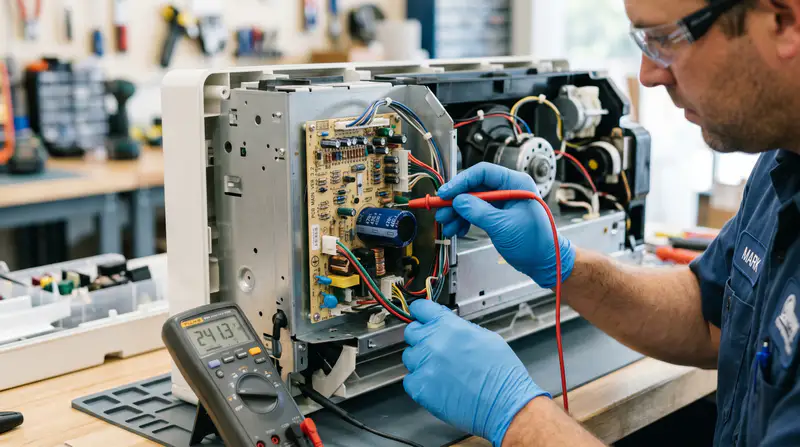
Quick Summary: Mastering AC Repair in Dubai
AC repair in Dubai demands rigorous technical expertise to counter extreme heat and high ambient dust levels. Common failures like blown capacitors, R410a refrigerant leaks, seized condenser fan motors, and faulty PCB control boards require precise diagnostic tools - from multimeters measuring microfarads to digital manifold gauges for subcooling analysis. Effective repairs not only restore cooling but significantly enhance energy efficiency and equipment lifespan.
Guide Directory (Jump to Section)
- 1. The Realities of HVAC Operations in the UAE
- 2. Refrigerant Circuit Failures: Leak Detection & Brazing
- 3. Electrical Diagnostics: Capacitors, Relays & PCBs
- 4. Compressor Amperage & Thermal Overload Testing
- 5. Airflow Dynamics: Evaporator Freezing & Blower Motors
- 6. Condenser Coil Heat Dissipation & Chemical Washing
- 7. Condensate Drainage: Preventing Indoor Water Leaks
- 8. Hyperlocal Factors: Balcony Enclosures & Ambient Heat
- Dubai AC Repair Cost Table (2026 Tariff)
- Frequently Answered HVAC Questions
1. The Realities of HVAC Operations in the UAE
Operating an air conditioning system in Dubai presents an unparalleled thermodynamic challenge. During peak summer, ambient temperatures routinely exceed 45°C (113°F) and relative humidity can spike to suffocating levels. An HVAC system is essentially a heat pump; it absorbs heat from indoors and rejects it outdoors. However, rejecting heat into an environment that is already 45°C requires the compressor to work at near-maximum design pressures, placing immense strain on every single component within the circuit.
At SAAD MAAZ Technical Services LLC, we approach AC repair not merely as a part-swapping exercise, but as an applied science. Modern inverter split ACs, VRF (Variable Refrigerant Flow) systems, and traditional ON/OFF rotary compressor units each have unique failure modes. Understanding the deep mechanics of these systems is crucial to executing repairs that will survive the harsh Dubai climate. This guide breaks down the core technical aspects of professional AC repair, offering a detailed look into how we diagnose and resolve complex cooling failures.
Experiencing a Complete AC Breakdown?
Our certified technicians are available 24/7 across Dubai for rapid emergency diagnostics and repairs.
2. Refrigerant Circuit Failures: Leak Detection & Brazing
The lifeblood of any air conditioner is its refrigerant - typically R410a, R32, or older R22 gas. The refrigerant circuit is a hermetically sealed closed loop. Under normal conditions, an AC unit will never "consume" gas. If the pressure drops, there is a physical leak within the copper piping. In Dubai, thermal expansion and contraction (due to massive day/night temperature deltas) often cause brass flare nuts at the indoor and outdoor connection points to loosen. Furthermore, microscopic vibrations over time can cause the copper U-bends in the outdoor condenser to rub against the chassis, creating pinhole leaks.
When an AC loses its refrigerant charge, several critical things happen. First, the suction pressure drops, causing the saturation temperature of the evaporator coil to plunge below freezing point. The moisture in the room condenses on the coil and instantly freezes, turning the indoor unit into a block of solid ice. This blocks airflow, causing the unit to blow warm air. Concurrently, the compressor - which relies on cool returning suction gas to cool its internal motor windings - begins to overheat drastically.
Professional leak repair requires strict protocol. We do not just "top up" the gas. We recover the remaining refrigerant using a specialized recovery machine. We then pressurize the entire circuit with Oxygen-Free Dry Nitrogen (OFDN) up to 400 PSI. Using ultrasonic leak detectors or micro-bubble trace solutions, we pinpoint the exact leak location. If the leak is on the copper pipe, we use an oxy-acetylene torch to braze the crack with high-silver-content solder. After brazing, we pull a deep vacuum down to 500 microns using a two-stage vacuum pump to boil off any non-condensable moisture inside the lines, before finally weighing in the exact factory charge of refrigerant using a digital scale.
3. Electrical Diagnostics: Capacitors, Relays & PCBs
Electrical failures are arguably the most common cause of AC breakdowns in Dubai. The extreme heat on rooftops and balconies causes electrical components to degrade at an accelerated rate. The dual-run capacitor is a prime example. This cylindrical component acts as a high-voltage battery that provides the initial massive jolt of electricity (starting torque) required to spin up the compressor motor and the outdoor fan motor.
When a capacitor's internal dielectric oil boils due to ambient temperatures exceeding 50°C, the capacitor bulges and loses its capacitance (measured in microfarads, µF). A failed capacitor means the compressor will attempt to start, draw locked rotor amps (LRA), and then trip its internal thermal overload protector with a loud "click." Diagnosing this requires safely discharging the capacitor and using a multimeter to test its µF rating against its labeled specification (e.g., 45/5 µF).
Beyond capacitors, the Printed Circuit Board (PCB) in modern inverter ACs is highly susceptible to voltage spikes. The PCB contains sensitive microprocessors, bridge rectifiers, and Intelligent Power Modules (IPMs) that convert incoming AC power to DC, and then invert it back to a variable frequency AC to control compressor speed. If an IPM blows or a simple relay contact welds shut, the entire outdoor unit will remain dead while the indoor unit displays an error code. Our technicians perform board-level diagnostics, testing thermistor resistance (ohms) and verifying low-voltage communication signals between the indoor and outdoor units.
Fast, Reliable Electrical Diagnostics
Don't let a blown capacitor keep you sweating. We carry premium heavy-duty parts for all AC brands and perform on-the-spot repairs.
4. Compressor Amperage & Thermal Overload Testing
The compressor is the heart of the air conditioning system. It is a highly engineered pump that pressurizes the low-pressure, low-temperature refrigerant gas coming from the indoor unit into a high-pressure, high-temperature gas to be sent to the condenser coil. When a compressor fails, the repair cost is significant. Therefore, accurate diagnostics are paramount.
We utilize clamp meters to measure the Running Load Amps (RLA) of the compressor while it operates. If the manufacturer's data plate states an RLA of 12.5 amps, but the compressor is pulling 18 amps, it indicates severe mechanical strain. This high amp draw could be caused by an overcharged system (too much refrigerant pushing head pressure too high), a severely dirty condenser coil failing to reject heat, or failing internal bearings within the compressor scroll or rotary mechanism.
We also test the compressor motor windings using the resistance (ohm) setting on a multimeter. We measure across the Common (C), Start (S), and Run (R) terminals. The resistance between C to S plus C to R must equal the resistance between S to R. If the reading is infinite (OL), it means a winding is broken or the internal thermal overload switch is currently open (tripped). If any terminal shows continuity to the copper casing of the compressor, the motor is "grounded" or "shorted to ground," meaning the compressor has suffered a catastrophic electrical burnout and must be replaced entirely. In cases of burnout, acid forms in the refrigerant lines, requiring the installation of suction and liquid line filter driers during the replacement process to clean the system.
5. Airflow Dynamics: Evaporator Freezing & Blower Motors
Airflow is the mechanism by which an AC actually cools your room. The indoor blower motor sucks warm room air through the return grilles and pushes it across the icy-cold evaporator coil. In Dubai, fine desert dust penetrates homes rapidly. If the return air filters are not cleaned every 2-3 weeks, they become a solid wall of dust, completely starving the blower of air.
Without sufficient warm air passing over the evaporator coil, the heat exchange process halts. The refrigerant temperature inside the coil drops rapidly below 0°C, and the humidity condensing on the fins freezes solid. The entire coil becomes a block of ice. Once frozen, zero air can pass through, and the AC stops cooling entirely. The solution involves melting the ice (often using a heat gun or running the unit on fan-only mode for hours), chemically cleaning the deeply embedded dirt within the coil fins, and potentially unblocking the microscopic capillary tubes or adjusting the Electronic Expansion Valve (EEV) if the pressure drop is mechanically induced rather than airflow-induced.
Furthermore, the indoor blower motor itself can fail. The cylindrical squirrel-cage blower fan relies on delicate motor bearings. Over time, these bearings dry out, causing severe friction, loud screeching noises, and reduced fan RPM. If the RPM drops, the airflow drops, again leading to a frozen coil. Replacing a seized indoor blower motor requires dismantling the entire indoor fascia, carefully removing the fragile plastic fan barrel, and wiring a new OEM motor into the control board.
Is Your AC Blowing Weak Air?
Poor airflow means higher DEWA bills and less comfort. Let us clean your coils and fix your blower.
Book a Tech Now6. Condenser Coil Heat Dissipation & Chemical Washing
The outdoor unit (condenser) works as a heat rejection machine. The hot, high-pressure gas from the compressor travels through hundreds of tiny aluminum fins. The outdoor fan pulls ambient air through these fins to carry the heat away, condensing the gas back into a liquid state. Because these units sit outside in Dubai, they are bombarded by sand, construction dust, and vehicle exhaust pollution.
When a thick layer of grime coats the condenser coil, it acts as a thermal insulator. The heat cannot escape. Consequently, the high-side liquid pressure spikes dangerously high (head pressure). This causes the compressor to work twice as hard, pulling massive amperage, overheating, and eventually tripping off. The AC will blow warm air until the compressor cools down hours later. This condition is often misdiagnosed by amateurs as a faulty compressor, when in reality, the unit simply cannot breathe.
Our repair protocol involves a high-pressure chemical wash. We apply a specialized, foaming, mildly acidic coil cleaner that chemically reacts with the baked-on dirt, pushing it out from deep within the aluminum fins. We follow this with a low-PSI hydro-wash to rinse the coil completely clean. This simple yet vital service restores heat transfer efficiency, drops operating pressures back to normal specs, and drastically reduces monthly electricity consumption.
7. Condensate Drainage: Preventing Indoor Water Leaks
As an AC cools the air, it simultaneously dehumidifies it. The extracted moisture drips off the evaporator coil into a plastic drain pan, where it is funneled outside through a PVC drain pipe. In Dubai's highly humid coastal environment, an AC can produce several liters of water per day.
The problem arises when dust bypasses the filters and mixes with this standing water in the drain pan. It forms a thick, biological slime or algae that completely blocks the narrow drain pipe. When the pipe clogs, the water backs up, overflows the drain pan, and drips down your walls, ruining expensive wallpaper, gypsum ceilings, and flooring. In severe cases involving ducted systems, water damage can lead to structural ceiling collapses.
Repairing a severe water leak involves using an industrial wet/dry vacuum to extract the sludge from the termination point of the drain line, or using compressed nitrogen blasts to clear the blockage. We then pour anti-algae biocide tablets into the drain pan to prevent future biological growth. We also ensure the AC unit is mounted perfectly level; even a slight tilt away from the drain hole will cause pooling and eventual overflowing.
8. Hyperlocal Factors: Balcony Enclosures & Ambient Heat
Repairing ACs in Dubai requires a deep understanding of local architectural nuances. Many high-rise apartments in areas like Deira, Bur Dubai, and Marina feature extremely confined balconies where multiple outdoor condenser units are stacked vertically. Tenants often place decorative screens or boxes around these units to improve aesthetics, severely restricting airflow.
This creates a phenomenon known as "short cycling" or a "micro-climate." The condenser discharges hot 55°C air, but because the balcony is enclosed, the fan just sucks that same 55°C air right back into the coil. The unit cannot cool itself. The compressor rapidly overheats and shuts down repeatedly. To fix this, our engineers perform airflow redirection modifications, installing custom louvers or deflector hoods on the condenser fan grilles to force the hot exhaust air up and out of the balcony, ensuring the unit draws in fresh ambient air.
Dubai AC Repair Cost Table (2026 Tariff)
At SAAD MAAZ Technical Services LLC, we believe in complete transparency. No hidden fees, no surprise charges. Below is our standard pricing matrix for common HVAC repairs in the UAE:
| Repair Service Type | Typical Price Range | Warranty Covered |
|---|---|---|
| Diagnostic & Callout Fee | AED 50 (Waived on repair) | N/A |
| Dual Run Capacitor Replacement | AED 150 - AED 250 | 90 Days Parts Warranty |
| R410a / R22 Minor Gas Top-Up | AED 150 - AED 250 | 30 Days Pressure Check |
| Major Leak Repair, Brazing & Full Gas Charge | AED 450 - AED 850 | 180 Days Brazing Warranty |
| Condenser Fan Motor Replacement | AED 280 - AED 550 | 90 Days Motor Warranty |
| PCB Board Component Repair | AED 250 - AED 450 | 90 Days Board Warranty |
Frequently Asked Questions (FAQ)
Why does my AC need frequent repairs in Dubai?
How long does a standard AC repair take?
What is the cost of AC repair in Dubai?
Is it better to repair or replace a faulty compressor?
About The Author: Saad Maaz
Lead HVAC Mechanical Director & Field Consultant
Saad Maaz is the Lead Technical Consultant at SAAD MAAZ Technical Services LLC. With over 12 years of hands-on experience troubleshooting, designing, and maintaining high-performance VRF, split, and commercial ducted air conditioning systems in Dubai, he provides expert HVAC diagnostic consultation to residential homeowners and corporate properties throughout the UAE.