AC Refrigerant Recharge in Dubai: The Right Way vs. The Wrong Way
SAAD MAAZ HVAC Engineering Team
Written by Saad Maaz (Lead HVAC Specialist) • Updated May 26, 2026 • 12 Min Read
Quick Summary
A proper AC refrigerant recharge is NOT just connecting a hose and opening a valve. It requires a nitrogen leak test to confirm the system holds pressure, a deep vacuum dehydration to remove moisture, and precision weight-based charging using a digital refrigerant scale. Skipping any step damages the compressor. At SAAD MAAZ, we follow ASHRAE best practices for every recharge.
Guide Directory
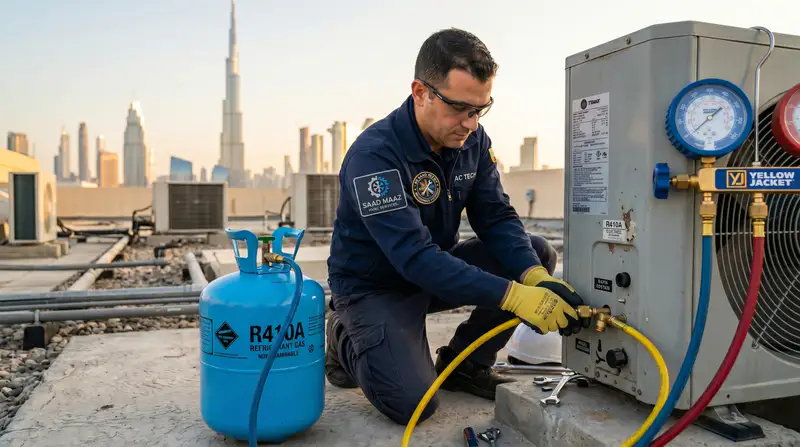
"Your AC needs gas" is perhaps the most overused - and most abused - phrase in Dubai's HVAC service industry. While it is true that a low refrigerant charge is a leading cause of poor cooling, the way the gas is recharged matters enormously. A careless top-up by an untrained worker can actually damage the compressor beyond repair.
At SAAD MAAZ Technical Services LLC, we approach every refrigerant recharge as an engineering procedure - not a quick fix. This guide explains the science behind refrigerant charging, the different types of gas used in Dubai, and why our method protects your investment.
Need a Professional AC Gas Recharge?
We leak-test first, vacuum-dehydrate the system, and use a digital scale to weigh in the exact factory charge.
1. The Sealed System Principle
An air conditioner is a closed, hermetically sealed refrigeration loop. The refrigerant gas circulates endlessly between the indoor evaporator and the outdoor condenser. It is never "consumed" or "burned up." The system is designed to hold its factory charge for its entire operational lifetime - 15+ years.
If a technician tells you your AC "ran out of gas," the only logical explanation is that the gas leaked out through a physical hole in the copper piping, a cracked flare joint, or a corroded coil. Recharging without finding and sealing this leak is like pouring water into a bucket with a hole.
2. R22 vs. R410a vs. R32: Know Your Gas
Three types of refrigerant are commonly found in Dubai AC systems:
| Property | R22 (Freon) | R410a | R32 |
|---|---|---|---|
| Era | Pre-2015 | 2010-Present | 2020-Present |
| Operating Pressure | ~70 PSI suction | ~120 PSI suction | ~130 PSI suction |
| Ozone Depleting? | Yes (Banned) | No | No |
| Cost per Recharge | Expensive (scarce) | Moderate | Moderate |
Critical Warning: R22, R410a, and R32 are NOT interchangeable. They use different compressor oils and operate at different pressures. Mixing refrigerants or charging an R22 system with R410a will cause catastrophic compressor failure and voided warranty.
3. The Wrong Way: Blind Top-Ups
A "blind top-up" is when a technician connects a gas cylinder, watches the suction pressure gauge, and stops adding gas when the pressure "looks about right." This is profoundly unreliable because gauge pressure varies with ambient temperature, airflow, and whether the unit is in steady-state operation.
Worse, if the system was fully empty, the technician introduces fresh gas into pipes that are contaminated with atmospheric moisture and air. The moisture reacts with the compressor's POE oil to form hydrofluoric acid, silently corroding the motor windings from the inside. The compressor might run for 6-12 months before the acid damage causes a winding short and catastrophic burnout.
Had a Bad Gas Refill? Compressor Noisy?
Contaminated refrigerant can destroy your compressor. Let us recover the bad gas and do it properly.
4. The Right Way: Test → Vacuum → Weigh
Our 3-step engineering protocol for every refrigerant recharge:
- Nitrogen Pressure Test: We pump the system to 400 PSI with dry nitrogen and monitor the gauge for 30 minutes. Any pressure drop confirms a remaining leak that must be repaired before gas is added.
- Deep Vacuum Dehydration: We connect a dual-stage rotary vane vacuum pump and pull a vacuum below 500 microns. We perform a 15-minute isolation decay test to confirm the system is leak-free and moisture-free.
- Precision Weight-Based Charging: Using a digital refrigerant scale accurate to ±5 grams, we weigh in the exact factory charge (printed on the outdoor unit's nameplate, e.g., 1.2 kg R410a). We then verify by measuring superheat and subcooling with a thermometer and manifold gauges.
5. The Dangers of Overcharging
Just as undercharging is harmful, overcharging the system with too much gas is equally destructive. Excess refrigerant causes abnormally high head pressure on the condenser side. The compressor must work much harder to push the extra liquid, drawing excessive amperage and generating extreme heat.
In severe overcharge cases, liquid refrigerant can slug back into the compressor's cylinder (liquid slugging), hydrolocking the piston or scroll mechanism. This causes immediate mechanical destruction. The only way to prevent both under- and over-charging is precision weight-based charging with a digital scale.
AC Refrigerant Recharge Cost Table
| Service Level | Price Range | What's Included |
|---|---|---|
| Basic Top-Up (Minor Low Charge) | AED 200 - AED 300 | Gauge check + small gas addition |
| Full Recharge (1-2 Ton Split) | AED 350 - AED 500 | Vacuum + precision weigh-in + verification |
| Full Recharge (3-5 Ton Ducted/Central) | AED 500 - AED 900 | Nitrogen test + vacuum + large gas charge |
| R22 Recharge (Legacy Systems) | AED 400 - AED 700 | Premium-priced due to R22 scarcity |
Frequently Asked Questions
How often does AC refrigerant need to be recharged?
What is the difference between R22 and R410a?
How much does AC gas refill cost in Dubai?
Why does the technician need to use a vacuum pump?
About The Author: Saad Maaz
Lead HVAC Refrigeration Specialist
Saad Maaz is the Lead Refrigeration Engineer at SAAD MAAZ Technical Services LLC. Certified in handling R410a, R32, and legacy R22 systems, he specializes in leak detection, vacuum dehydration, and precision refrigerant charging across Dubai's residential and commercial properties.